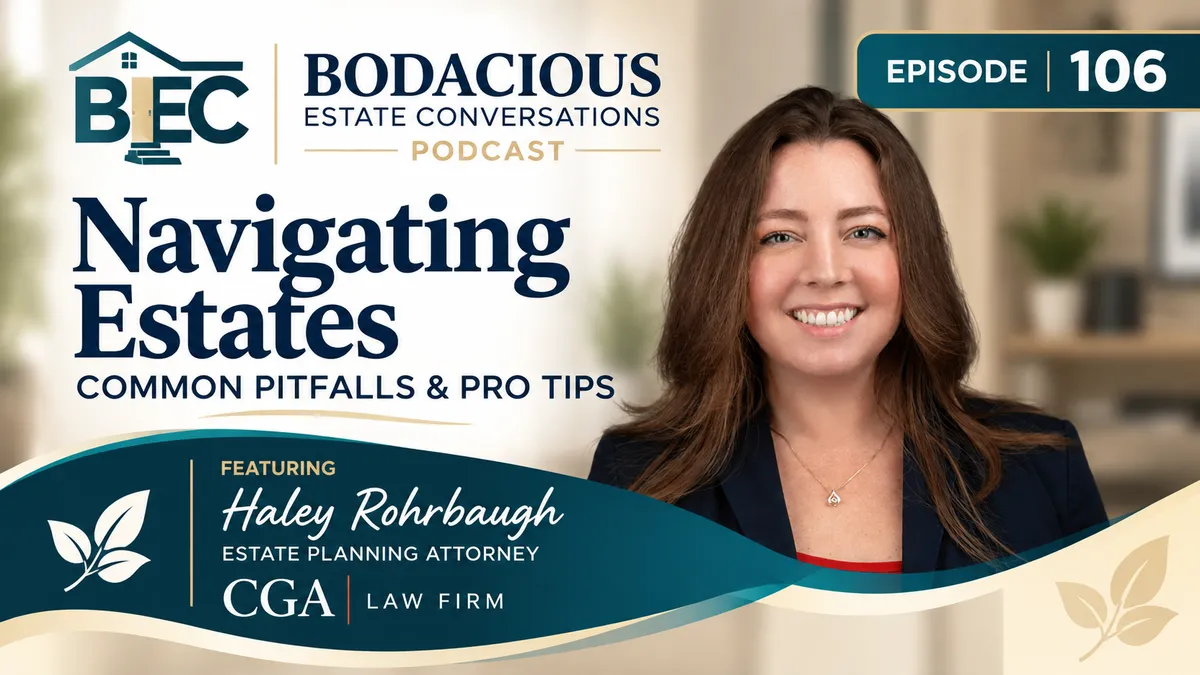
Estate Administration Mistakes: Advice for Executors and Families
Bodacious Estate Conversations | Episode 106
Featuring Haley Rohrbaugh, Estate Planning Attorney at CGA Law Firm
Being named the executor of someone's estate might sound like an honor. But when the time comes to fulfill that responsibility, many people discover just how complicated the process can become.
From disagreements between siblings to unexpected taxes, inherited property, and decades of accumulated belongings, settling an estate involves far more than distributing money.
In Episode 106 of Bodacious Estate Conversations, host Kasey King sits down with Haley Rohrbaugh, an estate planning attorney at CGA Law Firm, to discuss common mistakes families make when administering estates—and what they can do to avoid them.
With more than 20 years of experience in the legal field, Haley shares practical advice for executors, homeowners, and anyone who wants to make things easier for their loved ones.
1. The Biggest Estate Planning Mistake: Not Having a Will
According to Haley, one of the most common challenges begins before someone passes away: they never create a will.
Without clear instructions, family members may disagree about who should administer the estate, how property should be distributed, or what the deceased person would have wanted.
Even when a will exists, disagreements can arise if important decisions are left unclear.
Haley encourages people to create comprehensive estate planning documents and communicate their wishes before a crisis occurs.
The more decisions you make in advance, the fewer decisions your family may have to make while grieving.
2. Why Families Fight Over Who Becomes Executor
Being an executor involves significant responsibility.
The person administering an estate may need to identify assets, address creditors, coordinate property valuations, manage financial accounts, prepare required filings, and oversee distributions.
So why do family members sometimes disagree about who should take the role?
Haley explains that trust is often the underlying issue.
One sibling may believe another will not handle the estate fairly, particularly when there are longstanding family tensions.
When every decision is questioned, administration can become slower and more expensive.
Selecting a trustworthy, organized, and capable executor—and discussing that choice with your family—can help reduce future disputes.
3. Don't Wait Too Long to Contact an Estate Attorney
One of Haley's strongest recommendations is to seek legal guidance early after a loved one's death.
Estate administration can involve filing deadlines, valuation requirements, creditor issues, and tax considerations.
Haley discusses how obtaining timely property valuations can help families and their attorneys evaluate Pennsylvania inheritance tax obligations and any applicable early-payment discount.
She also shares an example of an estate that remained unresolved for nearly two decades. As time passed, the property and legal circumstances became increasingly difficult to manage.
Professional help eventually made it possible to move the property toward a sale.
The lesson: delaying estate administration can create complications that become more expensive to resolve.
4. What Happens to Everything Inside the House?
One of the most emotional parts of settling an estate is deciding what to do with personal belongings.
Family photographs, jewelry, furniture, collectibles, tools, and sentimental items may all carry different meanings for different family members.
Haley explains that problems can arise when relatives begin removing belongings before the executor has had an opportunity to identify and document estate assets.
Some items have little monetary value but enormous sentimental importance. Others may appear ordinary yet be worth thousands of dollars.
Her recommendation is to establish a clear process before distributing or removing property.
For potentially valuable items, the executor should consult the estate attorney about appropriate valuation and documentation.
5. How to Prevent Arguments Over Sentimental Belongings
Haley offers a practical suggestion: give meaningful items to loved ones while you're still alive, when appropriate.
For example, a parent with several children might invite them to choose jewelry or other sentimental possessions during a family gathering.
This creates an opportunity to share stories, explain the meaning behind objects, and build positive memories.
For people who prefer to retain their belongings during life, written instructions can help clarify their wishes.
Lifetime gifts can have legal, tax, and benefits-planning implications, so significant transfers should be reviewed with an attorney.
6. What If Multiple Siblings Want to Keep the Family Property?
Inherited real estate can create difficult decisions when several heirs want to retain the same property.
Haley shares an example involving four siblings who wanted to preserve a family cabin.
Rather than simply leaving ownership arrangements informal, she discusses how an LLC and a carefully prepared operating agreement may provide a structure for shared ownership.
That agreement can address questions such as:
Who pays property taxes and insurance?
How are repairs and maintenance funded?
Who can use the property, and when?
Can the property be rented?
What happens if one sibling wants to sell?
How are disagreements resolved?
An LLC is not necessarily appropriate for every inherited property. Families should evaluate ownership, financing, taxes, liability, and estate requirements with qualified professionals.
The important point is to establish clear expectations before disagreements arise.
7. Why Powers of Attorney Are So Important
One of the most urgent topics Haley discusses is the importance of powers of attorney.
Many people associate estate planning only with what happens after death.
But what happens if someone is still alive and becomes unable to manage their own financial or medical decisions?
Haley describes a situation involving an incapacitated property owner facing an imminent tax sale. A family member wanted to intervene but lacked the necessary legal authority.
A properly prepared power of attorney may allow an appointed person to take certain actions on someone's behalf, subject to the document's terms and applicable law.
Without appropriate legal authority, families may need to pursue guardianship or other court proceedings.
Estate planning isn't just about what happens when you die. It's also about protecting yourself while you're alive.
Because execution and authority requirements vary, Pennsylvania residents should consult an attorney rather than assume a generic online form will be sufficient.
8. When Should You Update Your Estate Planning Documents?
Haley recommends reviewing estate planning documents periodically, suggesting approximately every three to five years as a practical starting point.
You may also need a review after major life changes, including marriage, divorce, the birth of a child, the death of a beneficiary, significant changes in assets, or a move to another state.
An attorney can help determine whether existing documents still reflect your wishes and meet current legal requirements.
9. Sometimes Hiring Professionals Saves the Estate Money
Executors often feel obligated to handle every task themselves.
That may include sorting decades of belongings, cleaning out a house, scheduling repairs, arranging an estate sale, and preparing the property for the market.
But Haley makes an important observation: doing everything yourself doesn't necessarily save money if the work delays estate administration for months or years.
Professional cleanout companies, auctioneers, contractors, and property preparation specialists can help move the process forward.
This is particularly valuable when heirs live out of state, the property needs significant attention, or family members are overwhelmed.
10. Haley's Top Advice: Plan Before There's an Emergency
Haley closes the conversation with two central recommendations.
First, complete your estate planning documents. Don't assume you're too young or don't have enough assets to need a plan.
Second, make decisions about your belongings and wishes while you're able to do so.
Planning ahead can reduce uncertainty, help prevent family disputes, and make difficult transitions more manageable.
About Haley Rohrbaugh
Haley Rohrbaugh is an attorney with CGA Law Firm, with a professional background spanning bankruptcy, corporate law, and estate planning.
During the interview, she shares her path from working in a law office as a young adult to becoming an attorney, as well as her connections to York and Adams Counties.
She also discusses her involvement with the York County Estate Planning Council and her commitment to helping families navigate complicated legal situations.
To learn more about Haley and her practice, visit CGA Law Firm.
Watch or Listen to Episode 106
Navigating Estates: Common Pitfalls and Pro Tips
Need Help Managing an Estate Property?
Handling a loved one's estate can be overwhelming, especially when there's a home filled with belongings, repairs to coordinate, or family members living in different locations.
At Guided Home Prep, we help executors and families coordinate cleanouts, repairs, property preparation, and the practical steps involved in selling inherited real estate throughout South Central Pennsylvania.
You don't have to manage everything alone.
No pressure. Just clarity and a plan.
Start a Conversation With Guided Home Prep
Disclaimer: This article is for general educational purposes and is not legal, tax, or financial advice. Estate administration requirements vary by circumstance. Consult a qualified Pennsylvania attorney about your specific situation.