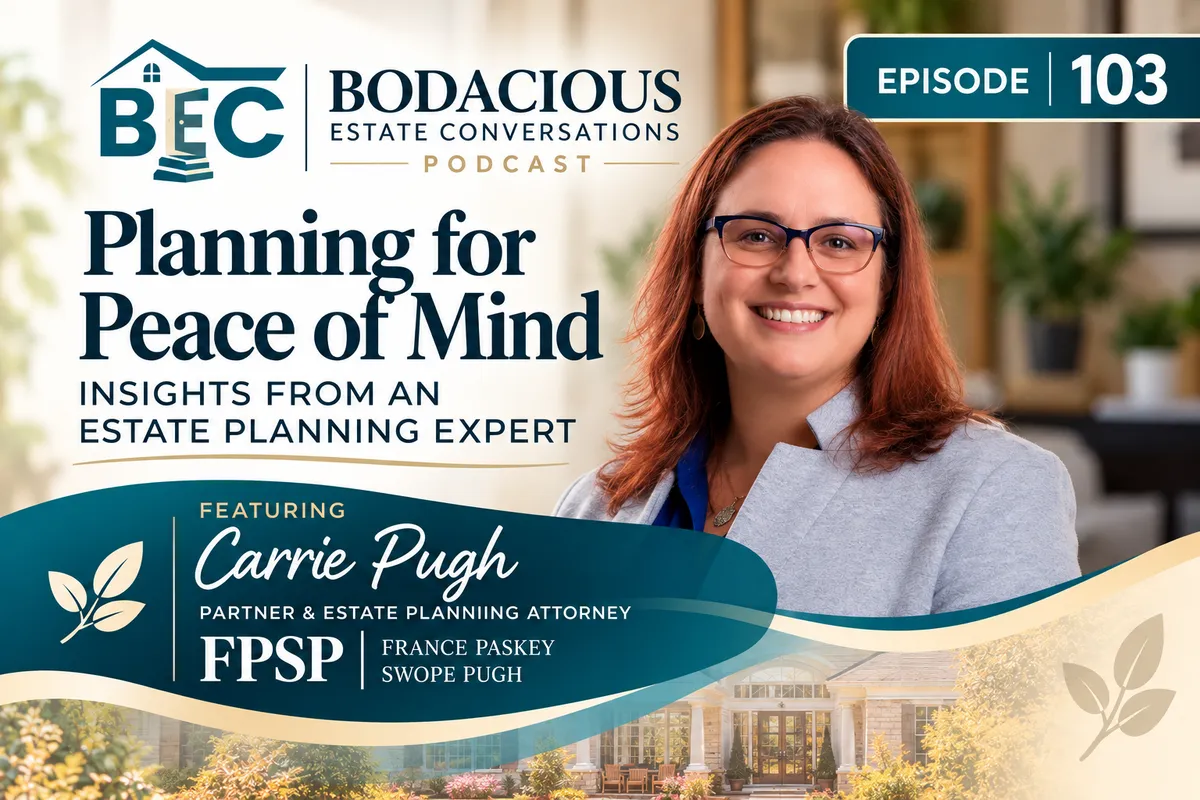
Estate Planning Before You Need It: Insights from Attorney Carrie Pugh
Bodacious Estate Conversations | Episode 103
Featuring Carrie Pugh, estate planning attorney and partner at FPSP Law Firm.
Most people know they should have a will. But what happens if you're still alive and suddenly unable to make decisions for yourself? Who can manage your finances, speak with your doctors, or make important decisions on your behalf?
In this episode of Bodacious Estate Conversations, I sit down with estate planning attorney Carrie Pugh to discuss the documents families often overlook, misconceptions about probate, and why planning ahead can prevent difficult situations from becoming even harder.
Carrie brings approximately 20 years of legal experience to the conversation, along with a deeply personal perspective on why estate planning matters.
Estate Planning Is About More Than What Happens After Death
One of the biggest misconceptions Carrie encounters is that estate planning simply means creating a will.
A will addresses important questions about what happens after death, but it doesn't provide the same protection for decisions that may need to be made during your lifetime.
Carrie encourages families to think about the broader picture:
Who would manage your financial affairs if you couldn't?
Who would make medical decisions if you became incapacitated?
Are your wishes documented clearly?
Would your family know where to find the necessary paperwork?
Have your documents been reviewed after major life changes?
A comprehensive estate planning conversation may involve a will, financial power of attorney, healthcare directives, and potentially trusts or other planning strategies.
The right combination depends on your family, assets, goals, and circumstances.
Why Powers of Attorney and Healthcare Directives Matter
Many married couples assume they can automatically make every financial or legal decision for one another.
As Carrie explains, that assumption can create problems.
Medical decision-making and financial authority involve different legal considerations. Even where state law provides a process for identifying family members who may make certain healthcare decisions, that doesn't necessarily grant authority over bank accounts or other financial matters.
For families with multiple adult children, unclear decision-making authority can also lead to disagreements.
Having appropriate documents in place can help identify who is authorized to act and provide guidance about your wishes.
The goal is to make difficult decisions easier for the people you love.
Carrie's Personal Experience Changed Her Perspective
Carrie's commitment to estate planning became personal after she experienced a massive stroke.
Despite being an attorney, she had not completed her own estate planning documents at the time.
She had no power of attorney, healthcare directive, or will.
Fortunately, she recovered, but the experience made her consider what her family might have faced if she had been unable to make decisions for herself.
That experience helped shift her professional focus toward estate planning and administration.
Carrie also shared the contrasting experience of her grandmother, whose carefully prepared healthcare documents provided valuable guidance when she became seriously ill.
Her mother was able to follow her grandmother's documented wishes during an emotionally difficult time.
These experiences illustrate why estate planning isn't just about distributing assets. It's also about protecting family members from unnecessary uncertainty.
Do You Need a Trust to Avoid Probate in Pennsylvania?
Probate is another topic that often causes confusion.
Carrie explains that probate is a legal process involved in administering certain estates after death. Whether it should be avoided depends on the circumstances.
One common misconception is that having a will automatically prevents probate.
It doesn't.
A will may still need to be admitted to probate, and different types of assets may require different administrative steps.
Trusts can sometimes help assets avoid probate, but creating a trust doesn't automatically eliminate every responsibility or delay associated with administering an estate.
Carrie also points out that owning property in multiple states can make probate planning especially important.
The takeaway is that avoiding probate isn't necessarily the right objective for every Pennsylvania family.
An attorney should review the assets involved and explain the advantages, limitations, and costs of the available approaches.
Can You Put a House With a Mortgage Into a Trust?
During our conversation, I asked Carrie a question many homeowners have: Can a property be placed into a trust if there's still a mortgage?
Carrie's response was that it may be possible, but the answer depends on the type of trust and the homeowner's specific circumstances.
Not all trusts work the same way.
Before making decisions about transferring property, it's important to understand how the trust is structured, what the homeowner hopes to accomplish, and what legal and lending considerations may apply.
This is one of many reasons personalized legal advice matters.
Why Online Estate Planning Templates Can Be Risky
Online legal documents can appear convenient and inexpensive.
However, Carrie cautions against assuming a generic document will adequately address an individual's needs.
Estate planning laws vary by state. Families also differ in ways that can substantially affect planning, including:
Blended families and second marriages
Children with special needs
Divorce or remarriage
Property ownership in multiple states
Changing health circumstances
Different financial and family goals
A document that works for a friend or relative may not be appropriate for someone else.
Carrie's recommendation is to discuss your situation with an attorney who understands the laws of your state and can recommend documents that work together.
Estate Planning Should Change as Your Life Changes
An estate plan shouldn't necessarily remain untouched for decades.
Marriage, divorce, the birth of a child, changes in property ownership, and major health events can all create reasons to review existing documents.
Carrie emphasizes the value of building an ongoing relationship with an attorney so questions and changes can be addressed as circumstances evolve.
This is particularly important when someone is named to make decisions on your behalf. That person should remain someone you trust and someone who is appropriate for your current situation.
Carrie's Number One Estate Planning Tip
At the end of our conversation, I asked Carrie to share the single most important piece of advice she would give families.
Her answer was simple:
"Plan before you need it."
Estate planning isn't reserved for retirees or people facing serious illness.
Carrie recommends that adults begin thinking about their planning needs early, including young adults heading to college, newly married couples, and individuals experiencing major life changes.
Some planning strategies require advance preparation, and waiting until a crisis occurs can limit the options available.
Having the conversation now can help protect both you and your family later.
About Carrie Pugh
Carrie Pugh is an attorney and partner at FPSP Law Firm, with a primary focus on estate planning and administration.
She previously spent much of her career practicing family law, experience that gives her insight into the complications that can arise during family transitions.
Outside her legal practice, Carrie enjoys horseback riding, hiking with her dog, reading, and endurance sports.
During the episode, Carrie shared that her firm offers initial estate planning consultations by phone, video, or in person. Contact the firm to confirm current availability and scheduling.
Watch or Listen to Episode 103
Need Help Navigating an Estate Property?
Estate planning attorneys help families address legal documents, decision-making authority, and estate administration.
When a home is involved, families may also need practical assistance with belongings, cleanouts, repairs, maintenance, downsizing, or preparing a property for sale.
That's where Guided Home Prep can help.
We work with homeowners, executors, and families navigating major property transitions in South Central Pennsylvania.
No pressure. No obligation. Just clarity and a plan.
This article summarizes a podcast conversation for general educational purposes and is not legal advice. Consult a qualified attorney about your specific circumstances. Real estate brokerage services are provided through Iron Valley Real Estate.