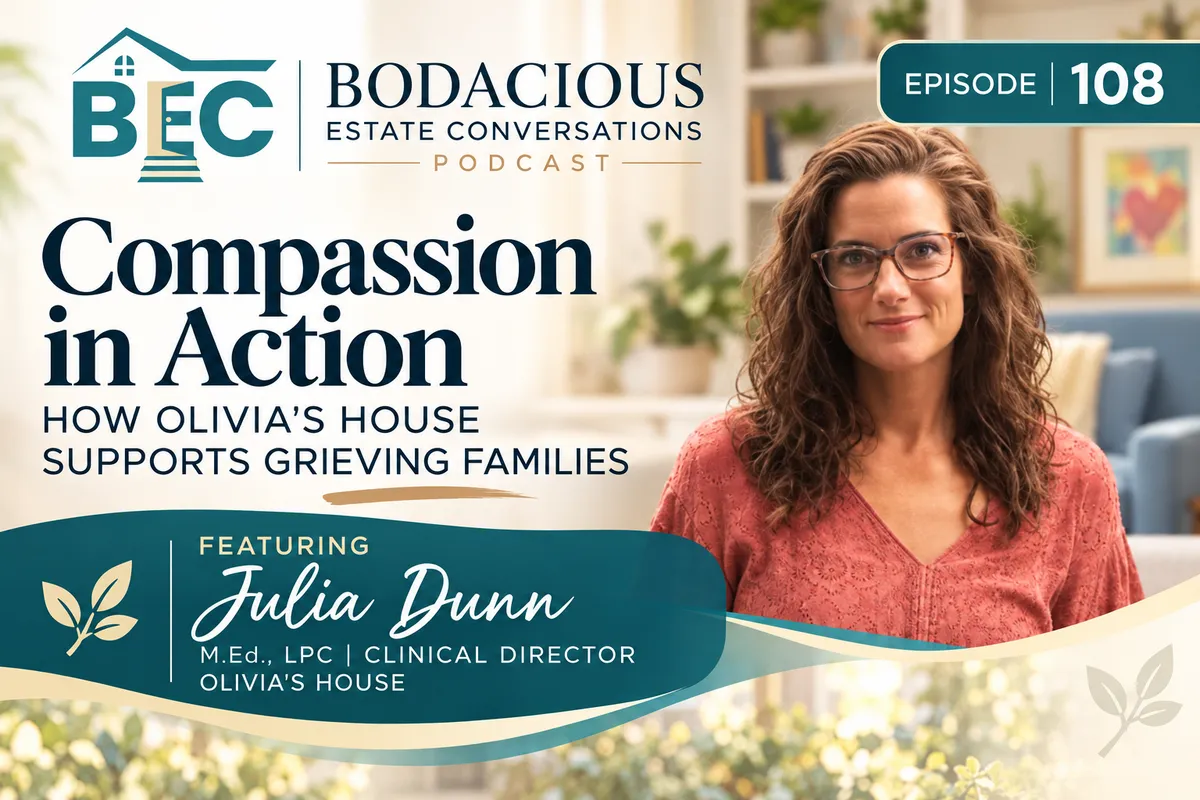
How to Help Grieving Children: Expert Advice from Olivia's House
Bodacious Estate Conversations | Episode 108
Julia Dunn | Olivia's House
Losing someone you love is difficult at any age. But when children experience grief, parents and caregivers often face an additional challenge: How do you explain death in a way a child can understand without making an already painful situation worse?
Many adults worry about saying the wrong thing. Others aren't sure whether their child's sadness, anger, or changes in behavior are normal. And when a family is also managing funeral arrangements, estate responsibilities, or a loved one's transition into care, finding the right words can feel especially overwhelming.
In this episode of Bodacious Estate Conversations, host Kasey King speaks with Julia Dunn, M.Ed., LPC, Clinical Director at Olivia's House, a grief and loss center serving children and families in the York and Hanover, Pennsylvania communities.
Together, they explore how children experience loss, why honest conversations matter, and how families can provide meaningful support throughout the grieving process.
How Do You Explain Death to a Child?
One of the biggest concerns Julia hears from parents is the fear of making grief worse by saying something wrong.
That fear often leads adults to soften their language when explaining a death.
Instead of saying someone died, they may explain that the person passed away, went to sleep, or is no longer here.
Although these phrases are usually intended to protect children, they can create confusion.
Young children often interpret language literally. They may not understand what it means to lose someone or why a person who has gone away cannot return.
Julia encourages adults to use clear, direct, age-appropriate language when talking about death.
That doesn't mean providing unnecessary or frightening details. It means helping children understand what has happened rather than leaving them to interpret vague explanations.
For parents who aren't sure where to begin, Olivia's House provides education and guidance tailored to the family's circumstances.
Children's Grief Doesn't Always Look Like Adult Grief
Adults often associate grief with prolonged sadness, crying, or withdrawal.
Children may experience those emotions, but they can also express grief differently.
Julia explains that children frequently experience what she calls grief bursts—periods when powerful emotions emerge and then subside.
These responses may include:
Crying unexpectedly
Becoming angry or frustrated
Having emotional outbursts or tantrums
Struggling with changes in familiar routines
Asking repeated questions about the person who died
Returning to normal activities shortly after an emotional moment
A child might be deeply upset one moment and happily playing the next.
That doesn't mean the child has forgotten the loss or is unaffected by it.
Julia emphasizes that many of these emotional responses are natural parts of bereavement. Families can benefit from understanding what is typical rather than assuming every difficult reaction requires immediate intervention.
Why Grief Doesn't Have an Expiration Date
It's common to hear that time heals all wounds. But grief doesn't necessarily follow a predictable timeline.
Julia describes bereavement as a lifelong process.
That doesn't mean someone will experience the same intensity of pain forever. Rather, the relationship with the person who died continues to influence life in different ways.
A child who lost a parent may experience renewed grief during birthdays, graduations, holidays, or other meaningful milestones.
Similarly, an adult may encounter unexpected reminders years after losing someone important.
Those moments don't automatically mean healing has stopped.
The goal isn't to erase grief. It's to develop ways to live with the loss while continuing to experience connection, purpose, and joy.
Understanding the Grieving Process: From Shock to Reconstruction
During the conversation, Julia discusses several parts of the bereavement process and why families shouldn't feel pressured to move through them quickly.
Shock and Numbness
Immediately following a loss, some people experience emotional numbness or feel disconnected from everyday life.
During this period, basic needs such as eating, resting, and maintaining simple routines can become the priority.
Julia describes this early period as a time of getting through each day rather than expecting immediate emotional progress.
Recognizing and Coping With Emotions
As the initial shock changes, stronger emotions may surface.
Children and adults may experience sadness, fear, frustration, anger, or confusion.
Julia encourages families to recognize those emotions and develop healthy ways of coping with them rather than attempting to eliminate them.
Supportive relationships, appropriate activities, familiar routines, and opportunities to express feelings can all play a role.
Reconstruction: Learning to Carry Loss Forward
Julia describes reconstruction as a later part of the grieving process.
It involves beginning to understand how the loss fits into your continuing life and identity.
For example, someone who loses a parent remains their child. A parent whose child has died remains a parent.
Those relationships do not simply disappear.
Reconstruction is about finding ways to carry those relationships and experiences forward while continuing to live.
Importantly, Julia cautions against rushing this process or using a new project or commitment to avoid difficult emotions.
Healing isn't about finding a shortcut. It's about making room for grief and developing the ability to move forward with it.
How Olivia's House Supports Grieving Children and Families
Olivia's House provides grief education and peer support programs designed to help children and their families navigate loss.
One of its established programs is Hearts Can Heal, which Julia explains serves children ages 6 through 18 and their parents or caregivers.
The program runs once a week for eight weeks.
Children participate in age-appropriate peer groups, while adults receive support and education in their own group.
This family-centered approach is particularly meaningful because grief affects more than the individual child.
Parents also need tools to understand emotional responses, maintain communication, and support their children at home.
For younger children, Olivia's House offers its Little Ones program for ages 3 through 5.
Julia also discusses how the organization uses age-appropriate environments and activities to help children feel comfortable expressing themselves.
Support Is Personalized to Each Family
Not every family needs the same type of support.
When someone contacts Olivia's House, staff begin by learning about the family's circumstances and concerns.
Depending on their needs, support may include grief education, lending-library resources, peer support programs, or referrals to outside mental health professionals.
An important distinction: Although Julia is a Licensed Professional Counselor, Olivia's House is not itself a traditional individual counseling center.
The organization focuses on grief education and peer support and can connect families with appropriate therapists when individual counseling or trauma-related treatment is needed.
Olivia's House provides its grief education and peer support services at no cost to families.
Supporting Children Before a Loved One Dies
Grief doesn't always begin after a death.
Families may experience significant emotional changes when someone receives a terminal diagnosis, develops a serious chronic illness, or experiences cognitive decline.
For children, watching a grandparent or parent change because of illness can be confusing and upsetting.
Julia explains that Olivia's House also helps families navigate these circumstances through pre-death support and education.
That may involve helping adults explain an illness, prepare children for what may happen, or facilitate meaningful conversations.
She also emphasizes the importance of maintaining a child's routines.
A parent may want their child to spend every possible moment visiting a seriously ill relative, but long or frequent visits may not always serve the child's emotional needs.
Children still need opportunities to attend school, play, spend time with friends, and experience the ordinary parts of childhood.
Finding the right balance requires paying attention to each child's needs.
Even the Loss of a Pet Deserves Compassion
For many children, losing a pet is their first experience with death.
Adults sometimes underestimate the significance of that loss, especially when the pet was small or had only been part of the family for a short time.
But Julia explains that the emotional impact is not necessarily determined by how long the pet lived with the family.
A dog that slept beside a child every night may have been part of nearly every daily routine.
When that companionship disappears, the child may feel the loss deeply.
Olivia's House offers resources to help families understand and support grief following the death of a pet, too.
About Our Guest: Julia Dunn
Julia Dunn, M.Ed., LPC, is the Clinical Director at Olivia's House: A Grief and Loss Center for Children.
Julia began her involvement with Olivia's House as a volunteer companion in 2013 before joining the staff and eventually becoming Clinical Director.
She earned a bachelor's degree in psychology from Lebanon Valley College and a master's degree in school counseling from Millersville University.
Julia's commitment to helping grieving children is also personal. She experienced the sudden death of her father when she was 12 years old and later drew upon that experience in her professional work.
Today, she helps children, parents, and caregivers understand the grieving process and identify supportive resources.
Connect with Olivia's House
Website:www.oliviashouse.org
York: 717-699-1133
Hanover: 717-698-3586
Email Julia:[email protected]
Watch or Listen to the Full Conversation
Compassion in Action: How Olivia's House Supports Grieving Families
Hear Kasey King and Julia Dunn discuss children's grief, coping skills, emotional resilience, and the importance of supporting the entire family after a loss.
Navigating a Family Transition? You Don't Have to Figure It Out Alone.
Losing a loved one or helping an aging family member transition into a new living arrangement can bring both emotional and practical challenges.
Along with supporting one another through grief, families may need to make difficult decisions about an inherited house, belongings, property maintenance, or preparing a home for sale.
At Guided Home Prep, we help homeowners, executors, heirs, and families throughout South Central Pennsylvania understand their real estate options and develop a practical plan for their next steps.
We recognize that the house is often more than a property. It may represent years of memories, family relationships, and a chapter of life that isn't easy to close.
Our role is to help you navigate the property decisions with clarity, patience, and practical support.
You don't have to figure this out alone.
Start a Conversation With Guided Home Prep
No pressure. Just clarity and a plan.
This article is intended for general education and is not a substitute for individualized mental health care, medical advice, or legal guidance. Families who need counseling or specialized support should contact a qualified professional.