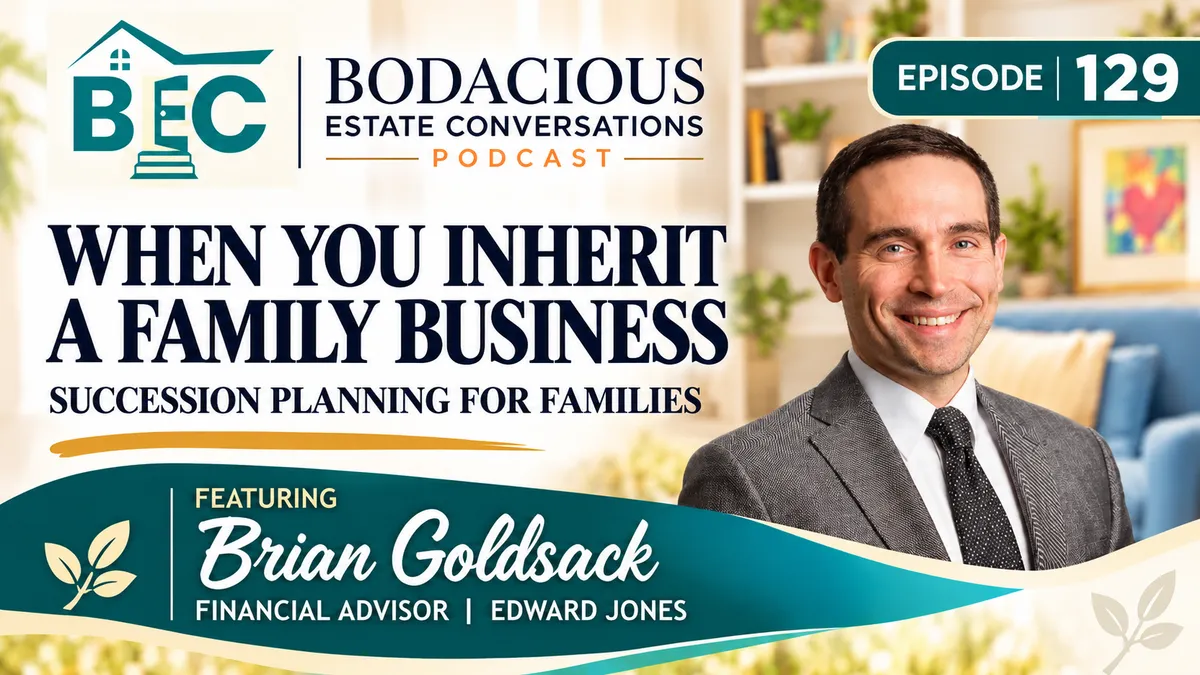
Inheriting a Family Business: Succession Planning for Families
Bodacious Estate Conversations | Episode 129
Featuring Brian Goldsack, Financial Advisor at Edward Jones
Inheriting a business can bring opportunity, but it can also leave a family with urgent decisions at a difficult time. Who will run the company? Should it be sold, continued, or transferred to someone already involved? And how can the family understand what the business is worth?
On Episode 129 of Bodacious Estate Conversations, host Kasey King talks with Brian Goldsack, a financial advisor with Edward Jones, about why business succession planning matters to owners and their families. Their conversation explores business valuation, planning for an owner’s departure, ways to exit gradually, and the risks of waiting until a crisis.
A business needs its own succession plan
A will can state who inherits a business. But, as Brian explains, it may not answer every practical question about keeping the company operating, transferring responsibilities, or protecting private business information. A will generally becomes part of a public probate process, while other arrangements may provide different ways to structure a transfer. The right approach depends on the owner’s circumstances and should be discussed with appropriate legal and financial professionals.
Planning ahead gives the owner time to consider who might take over, what the heirs want, and whether the business can function without its founder. Without that preparation, family members may have to make decisions while grieving and while also trying to keep the company running.
Understanding what a business may be worth
Brian describes two broad ways to think about business value. One focuses on the company’s cash flow: what income might a buyer expect from the business as it operates? Another looks at its assets, such as equipment, inventory, and property.
A valuation can also depend on the industry, the company’s performance, risk, and how attractive it is to potential buyers. Industry multiples can offer a rough reference, but they do not provide a precise value on their own. The final value depends on the business and the details of a potential transaction.
For families who inherit a business, an informed valuation can help frame the choices ahead. It may help them decide whether to continue operating the company, bring in new leadership, or explore a sale.
Reduce the business’s reliance on one person
One of the clearest takeaways from the conversation is Brian’s advice to reduce owner dependency. A company may be profitable, but if one person handles nearly every essential task, the business could struggle when that person is no longer available.
This can be especially important for small service businesses that rely on a licensed owner or founder. Families may need to determine which duties require specific qualifications, who could perform them, and whether the company has documented processes and capable people to carry its work forward.
The more a business depends on one person, the harder it may be for a buyer or successor to continue it. Building systems, sharing knowledge, and developing other leaders can help make the company less dependent on its owner.
Consider a gradual transition
Succession does not always have to mean an immediate sale. Brian describes several possible paths, depending on the business and the owner’s goals. An owner might gradually transfer responsibilities and sell portions of the business to senior employees or managers. A strategic buyer, such as a competitor, may be interested in the company’s clients, territory, or other business assets. Some owners may also consider selling a majority stake while staying involved for a transition period.
Each option has different implications for the owner, employees, family, and future operations. Brian emphasizes that a business owner should first understand the company’s value and consider how much of their personal net worth is tied to it. A phased plan can give the owner time to reduce that concentration and prepare for a transition.
Start tax conversations early
Taxes can affect the proceeds and structure of a business sale. In the episode, Brian discusses how a sale of business assets may have different tax consequences from a sale involving goodwill. The details can be complex, and the right treatment depends on the transaction and the owner’s circumstances.
His guidance is to involve a qualified tax professional early in the planning process. Business owners should not rely on a general example to predict their own tax bill. A CPA and other qualified professionals can help evaluate the specific business and transaction.
Make time for planning before a crisis
Brian says one common mistake is having no succession plan at all. Owners who are deeply involved in daily operations may find it easy to postpone planning. But an unexpected illness or death can leave family members with little time to understand the company and make decisions.
A practical first step is to gather information and speak with professionals who work with business owners on succession and exit planning. Brian said that, for qualified families whose businesses generate at least $1.5 million in revenue, his initial consultations are at no cost. Business owners should confirm current eligibility and the scope of any services directly with him.
Brian Goldsack is a financial advisor with Edward Jones. In the episode, he shares that he grew up in northeastern Pennsylvania, attended the University of Scranton, earned an MBA, and later joined Edward Jones. His interest in succession planning grew from working with business-owning families and recognizing the value that can be tied up in a company.
Watch or listen to Episode 129
Disclaimer: This article is for general educational purposes and is not legal, tax, investment, or financial advice. Consult qualified professionals about your specific circumstances.
If you’re handling an inherited property as part of a family transition, start a conversation with Guided Home Prep. No pressure. Just clarity and a plan.