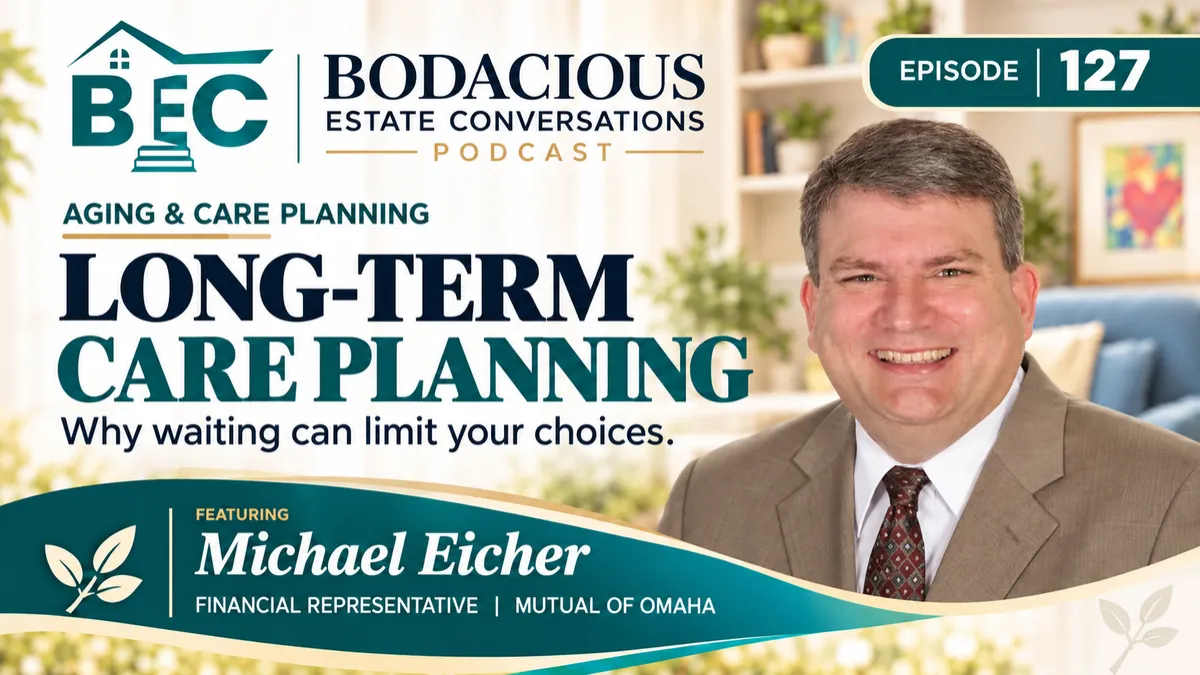
Long-Term Care Planning: Why Waiting Can Limit Your Choices
Bodacious Estate Conversations | Episode 127
Featuring Garrett Rohrbaugh, Financial Representative at Mutual of Omaha
Long-term care can mean many things: help at home, adult day services, assisted living, nursing care, or support for someone living with significant memory loss. Yet many families put off planning because they picture only a nursing home—or assume care will never be needed in their family.
On Episode 127 of Bodacious Estate Conversations, host Kasey King talks with Michael Eicher, a Financial Representative with Mutual of Omaha, about the range of care options, how families may prepare financially, and why it can help to start the conversation before a health change forces immediate decisions.
Listen on Spotify · Listen on Apple Podcasts · Watch on YouTube
Long-term care is a spectrum of support
The phrase “long-term care” can bring to mind a facility and round-the-clock help. But care needs vary. Some people may need assistance while continuing to live at home. Others may benefit from adult day services or assisted living. More intensive nursing or memory care may become appropriate as needs change.
Eicher notes that care needs can develop gradually, though an illness or other major event may cause a sudden change. Planning is easier when families consider the possible range of support rather than treating care as a single future event.
A useful first step is to talk about preferences: what would help a family member remain independent, what support might relatives realistically provide, and what care settings could be considered if needs increase? These conversations do not predict what will happen. They help families understand the decisions they may face.
Waiting can affect the available options
Eicher says that age and health can affect eligibility and cost for insurance products intended to help pay for care. Someone who waits until health issues arise may find it harder to qualify for some coverage or may have fewer choices. The right timing and options depend on each person’s circumstances.
Planning early does not mean every family needs to buy insurance. It means learning what choices exist while there is time to compare them. Eicher describes a fact-finding process that can include reviewing a person’s goals, financial picture, health history, and comfort with the cost of different approaches.
For families, that suggests a practical starting point: gather current information before making decisions. Review savings and retirement accounts, consider how much of a care cost the family could manage, and discuss what tradeoffs feel acceptable. A plan should fit the household’s priorities and budget.
Compare ways to prepare for care costs
Insurance is one approach discussed in the episode, but it is not the only one. Eicher describes traditional long-term care insurance, life insurance policies that may include long-term care features, certain annuity products, and setting aside personal savings. Each approach has different terms, costs, eligibility requirements, and potential benefits.
Some policies may offer benefits that grow over time or have tax features for qualifying care expenses. Those details vary by policy and individual situation, so families should review the contract and seek qualified financial and tax guidance before relying on a particular feature. Traditional long-term care premiums may also change; Eicher notes that rate increases have occurred in the industry.
When comparing options, ask:
What types of care and settings may be covered?
What conditions must be met before benefits are available?
How much could the plan cost now and over time?
What happens if the policyholder never needs care?
What alternatives are available if someone cannot qualify for coverage?
The answers can help families compare a policy with other ways of preparing, rather than focusing on a single product.
Understand the roles of Medicare and Medicaid
The episode also addresses confusion about government programs. Medicare and Medicaid are different programs, and neither should be assumed to cover every long-term care expense. Medicaid eligibility and treatment of assets depend on applicable rules and a person’s circumstances. Eicher cautions that transferring assets to family members as a way to qualify can have consequences, including look-back rules.
Because these rules are complex and vary by state and situation, families should not rely on a podcast conversation to make eligibility or asset-transfer decisions. A qualified elder-law attorney or benefits professional can explain the rules that apply to a specific case. An insurance or financial professional can help assess other planning choices.
Include care planning in the broader estate conversation
Long-term care planning connects with other decisions families may need to make. Eicher encourages people to review their broader financial and estate plans, including beneficiary arrangements and documents that designate who can act if someone becomes unable to make decisions.
A plan made years ago may no longer reflect a family’s current circumstances. Reviewing documents and discussing responsibilities with loved ones can reduce uncertainty during a stressful transition. Families may also want to identify professionals—such as an attorney, financial representative, or care provider—who can answer questions within their area of expertise.
The goal is not to find one perfect solution. It is to understand the options, document important decisions, and give family members a clearer place to begin.
Meet Michael Eicher
Michael Eicher is a Financial Representative with Mutual of Omaha. In the episode, he discusses helping individuals and families explore insurance and financial approaches to long-term care planning. He can be reached at [email protected].
This article is for general educational purposes and is not legal, insurance, tax, or financial advice. Coverage terms, tax treatment, and Medicare or Medicaid rules depend on the specific circumstances and may change. Consult qualified professionals before making decisions.
Start with a conversation
You do not have to sort through every home or family transition alone. Start a conversation with Guided Home Prep. No pressure. Just clarity and a plan.