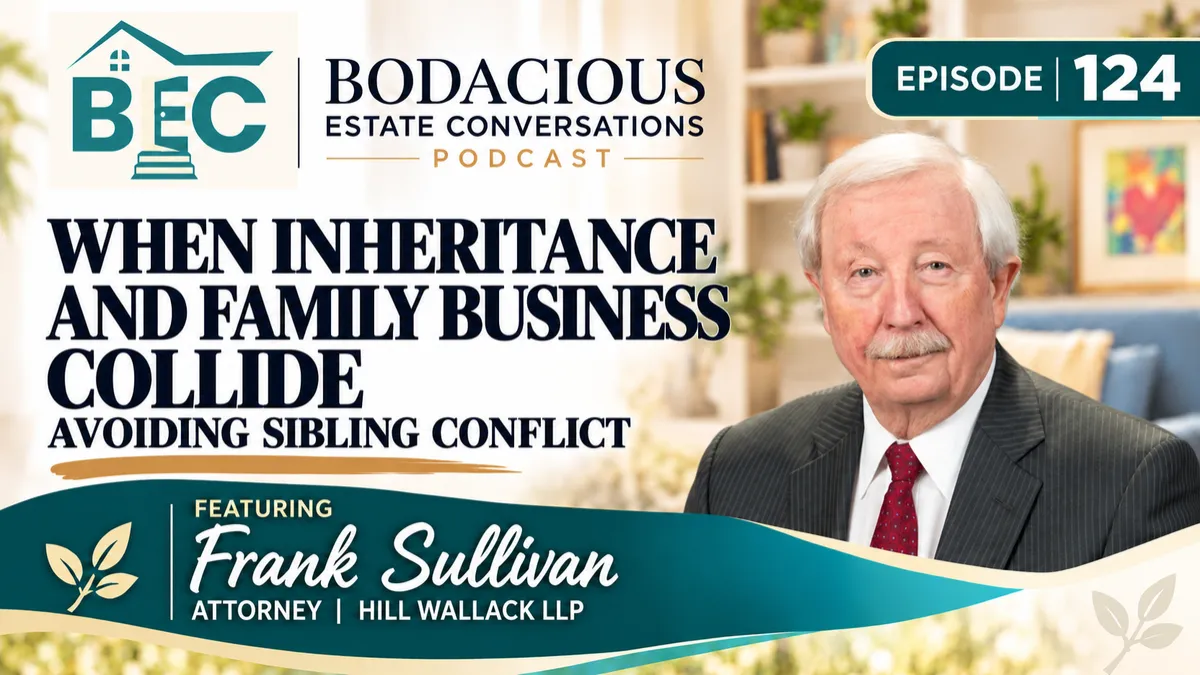
When Family Inherits a Business: Planning for Sibling Conflict
Bodacious Estate Conversations | Episode 124
Featuring Frank Sullivan, Attorney at Hill Wallack LLP
Inheriting a business can bring responsibilities and decisions that families may not face when an estate includes a home or financial accounts alone. Who will operate the business? Should a family member buy out the others? What if some heirs want to sell while another wants to continue?
On Episode 124 of Bodacious Estate Conversations, host Kasey King speaks with Frank Sullivan, an attorney with Hill Wallack LLP, about the challenges that can arise when inheritance and business ownership meet. Their conversation centers on one practical idea: planning ahead can give family members clearer options when a business owner dies, retires, or can no longer run the business.
Why inheriting a business can create conflict
A business may pass to people with different interests, experience, and expectations. One sibling may already be involved in daily operations, while another may prefer to receive money from the estate or sell the company. If ownership transfers without a plan for who makes decisions and how disagreements are handled, conflict can follow.
Sullivan describes how unresolved disagreements can lead to a buyout or a sale. A buyout may create financial pressure for the business and its remaining owners. A rushed sale can also affect the company’s value, particularly when customers rely on specific owners or employees for the service they receive.
That is why estate planning for a business involves more than naming who inherits. Owners and families also need to consider how the business will operate during a transition and how different heirs’ interests might be addressed.
Start succession planning before a crisis
Sullivan encourages business owners to discuss what should happen if an owner dies, retires, or becomes unable to work. These conversations can feel difficult, but addressing them earlier gives owners and co-owners more time to consider their goals and document their decisions.
For a business with multiple owners, a written agreement can set out how an ownership interest may be handled after a triggering event. Depending on the business structure and the owners’ circumstances, that might include who can buy an interest, how the business will be valued, and whether payment would be made at once or over time.
Sullivan discusses operating agreements for limited liability companies and shareholder agreements for corporations as examples of documents owners may use to record their arrangements. The appropriate documents and terms depend on the business and require advice from qualified professionals.
Owners should also consider independent legal advice for each co-owner. As Sullivan explains, co-owners may have different interests, even when they are starting a business together. Each person should understand their own rights and obligations before agreeing to a plan.
Think through funding and business valuation
A buyout plan needs to address how the purchase could be funded. In the conversation, Sullivan discusses life insurance as one possible source of funds in some ownership arrangements. Insurance involves its own costs, terms, and planning questions, so families should not assume it will fit every situation.
Valuation is another important question. An accountant or a qualified business valuation professional may help assess what a company is worth. The process can be more complicated for service businesses, where a significant part of the value may depend on the owner, employees, customer relationships, or the business’s ability to keep serving clients after a transition.
Owners can make future decisions easier by keeping reliable financial records and discussing valuation methods in advance. A written plan can also address when a valuation is needed and who will select the professional.
Give the executor a workable plan
When a business is part of an estate, the executor may have to address decisions that go beyond distributing personal belongings. The executor’s responsibilities depend on the will, the estate, and applicable law. If the business is still operating, the estate may need to preserve its value while determining what should happen next.
Sullivan emphasizes the importance of following the will and understanding fiduciary responsibilities. He also notes that trusts and other planning tools may be considered during an owner’s lifetime. The right approach depends on the family’s circumstances and should be discussed with an estate planning attorney.
Families can help prepare an executor by keeping key documents organized and identifying the professionals familiar with the business, such as its attorney and accountant. Clear records and instructions may help reduce confusion during an already difficult period.
Make room for both the business and the family
A succession plan is not only a financial document. It can also reduce uncertainty about who has authority, what each heir can expect, and how disagreements will be addressed. Families may still have different views, but documented expectations can give them a place to start.
Sullivan also raises a smaller but meaningful estate-planning detail: family photographs can hold important memories. Families may want to make copies so that more than one branch of the family can preserve them.
The larger lesson is to start the conversation before a death or other crisis forces decisions. Business owners can review their estate documents, talk with co-owners and family members, and consult appropriate legal, accounting, insurance, and valuation professionals.
Frank Sullivan is identified in the Guest List as an attorney with Hill Wallack LLP. In this episode, he shares perspectives on business succession, family conflict, estate administration, and planning for ownership transitions.
Listen or watch Episode 124:
This article is for general educational purposes and is not legal, tax, financial, or insurance advice. Laws and individual circumstances vary. Consult qualified professionals about your situation.
Start a Conversation With Guided Home Prep
No pressure. Just clarity and a plan.